Category Archives: Uncategorized

Have bicycle, will travel

Few, if any, cities across this continent can offer an experience that rivals the majestic pleasure of cycling across the Golden Gate Bridge, particularly on the rare warm day in June with the sun blazing, the wind negligible, and the fog rest comfortably in Fresno—where it should remain. Avid readers here know that Your West Coast Oenophile was waylaid by an industrial truck on Market Street back in March 2013. The three cracks in my cycling helmet will attest to what might have been, and my sorely diminished savings account will account for what actually did occur.
Three months later, my Trek 1.2 was purloined in a basement robbery, leaving me without my preferred two-wheel mode of inner city transportation until Santa Claus decided I hadn’t merited another year of coal in the stocking. And so while I have managed to keep Sostevinobile alive and vibrant over the past 16 months, I have not been able to make the excursion from my perch in Pacific Heights to the rainbow playground of Marin.
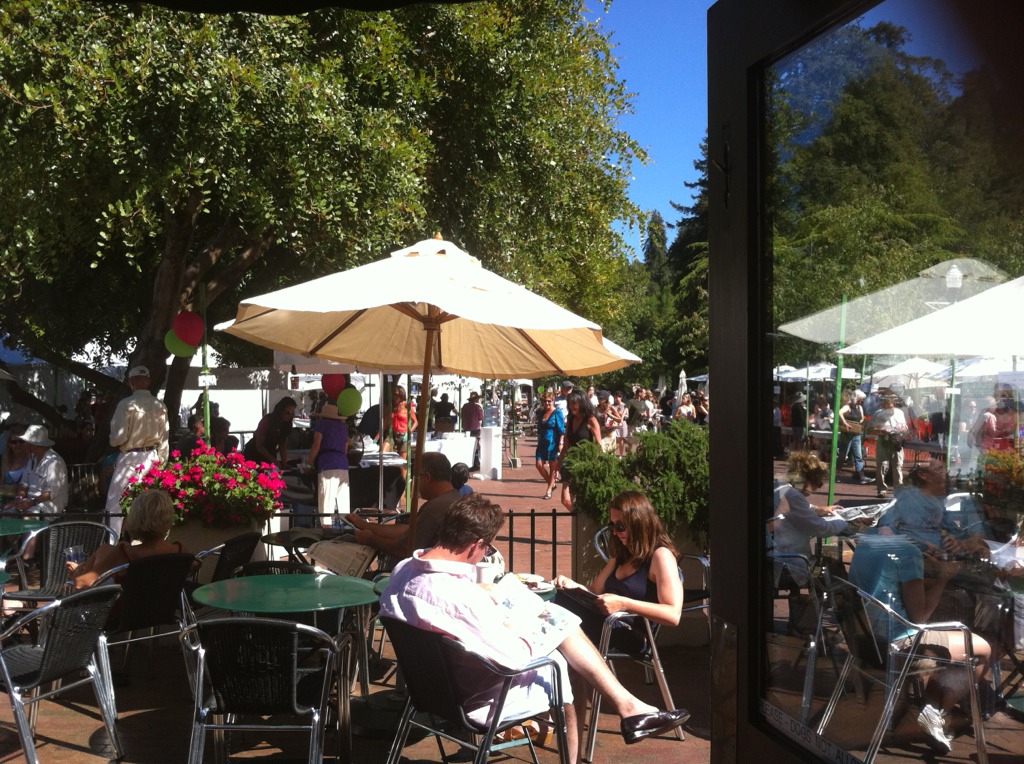
All that will finally change this coming Sunday, as my blue & black Scattante CFR Comp Carbon Road Bike and I head over the Golden Gate, dodging the inevitable horde of wannabe cyclists wreaking havoc on their Blazing Saddles rentals to the 33rd Annual Mill Valley Wine, Beer and Gourmet Food Tasting.
This extravaganza has only gotten better with each passing year and affords the local community a rare chance to sample wines from not only prestigious local labels but a number of boutique and esoteric producers who rarely showcase their offerings.
This festival isn’t just about wine, of course. The proliferation of artisan beers throughout California will also be well represented, and many of Marin’s finest restaurants and food purveyors will be on hand to satisfy almost any appetite. But beyond the food and festivities, this annual fundraiser supports both Kiddo!, the non-profit Mill Valley Schools Foundation, as well as the Mill Valley Chamber of Commerce and its beneficiaries. Tickets can be purchased online from the event’s Brown Paper ticket site.
It would be great if everyone walked or cycled to the Mill Valley Wine, Beer and Gourmet Food Tasting—free bicycle parking concierges will be on site, but it’s OK to arrive by car, as well. But, as always with events like this, remember the cardinal rule of driving: DO NOT RUN ME OVER!
I look forward to seeing everyone there.

Spring cleaning

It’s not that T. S. Eliot was wrong. The culprit is likely global warming and how it has wreaked havoc on climate patterns around the world. Suffice it to say that, at least for Your West Coast Oenophile, May is now officially the cruelest month.

I have been assiduously developing Sostevinobile for over 30 months now, not only financing it out of my own pocket, but forgoing (not necessarily by choice) almost any personal income in the process. In turn, this situation has raised quite a number of challenges on several fronts, and in order to address these, I have had to set aside much of my responsibilities for creating our wine program and maintaining this exhaustive blog over the past four weeks. My backlog of tasting notes is enormous, and while I can feebly try to apologize to those for whose events I owe detailed chronicles, I must still give all somewhat short shrift here if I ever hope to bring things up to date. 
Of course, if I’d ever learned the art of succinct composition, I might not be in the midst of this dilemma in the first place. Oh well, let me give it a whirl:


The 10th Annual Wine Industry Conference: Sometimes, I attend function that—gasp!—does not even include a tasting component, but nonetheless offers great portent for the wineries with which Sostevinobile will be dealing. And so I managed to drag myself out of bed, just as the sun was rising, and lumber up to the familiar settings of the Hyatt Vineyard Creek in Santa Rosa for the all-morning session. Growers, winemakers, investment bankers, journalists, and assorted trade and media folks filled the conference room, as two very distinct panels addressed the state of the wine industry in 2011, seen from their particular vantage.

The first session spoke to the need for the wine industry to engage its newest consumer base with social media. Granted, this is an area where I hold tremendous skepticism, for not only is the convivial and sensory nature of wine the diametric opposite of this phenomenon, much of my impetus for starting Sostevinobile stems from a desire to extricate myself from the vicissitudes of content creation (professionally, I’ve written 60+ Websites from top to bottom) and online marketing, as well as the emotional placebos derived from Facebook friends, Twitter followers, etc. Still, the four panelists: Bill Leigon of Hahn Family Wines, Larry Dutra from the Adams Wine Group (owners of White Cottage and Adler Fels), Ron Denner, whose Denner Vineyards markets almost exclusively through their Krewe Comus Club, and Jordan’s Lisa Mattson all extolled the potential these new media offer for engaging customers to interact with not only their wine but the entire winery experience, while retaining their loyalty through instant feedback and personalized communications. Despite my lingering ambivalence, points well taken.

Following the break, a sextet of major players in winery Mergers & Acquisitions took the stage; having practiced in this area throughout the 1980s, I held keen interest in their observations. This blue chip panel included Mario Zepponi from his eponymous Zepponi & Company, which last year had brokered the acquisitions of Chalk Hill, Black Stallion, and Four Vines; Bill Foley, whose assemblage of the burgeoning Foley Family Wines conglomerate, earned him the 2010 Man of the Year Wine Star Award from Wine Enthusiast Magazine; Dan Leese of V2 Wine Group that evolved out of Red Truck following Fred Franzia’s predation; Vincraft’s Peter Scott, the current owners of Kosta Browne; megamarketer Peter Byck from Winery Exchange; and Stewart Resnick, whose environmentally-untenable Fiji Water had recently acquired prominent green proponent Justin from Paso Robles. Their uniformly optimistic observations focused on how the devolution of large, publicly-held enterprises like Foster’s and Diageo had given enabled the ascendancy of private holdings like Foley, Purple Wine, and Precept, which have been responsible for most acquisitions of premium brands over the past few years.

Many attendees, however, found this session somewhat disingenuous. Forecasts of future acquisitions of numerous properties from both Foster’s and Ascentia became far less prescient with the announcement, just two hours after the conference, of the sale of Buena Vista to Boisset Family Estates and Gary Farrell to panelist Vincraft. Conspicuously absent from the discussion, too, was Foley Family Wines’ acquiring a major stake in contract winery Crushpad, which they subsequently relocated to their now underutilized Sebastiani plant less than a year since Crushpad had built facilities at Premier Pacific’s property at the bae of Silverado Trail.

In the end, I suppose the 10th Annual Wine Industry Conference offered no earth-shattering revelations, but at least I did get an honest insight into what goes on in the world before 9 AM.


In my previous post, I lamented the attrition in attendance at Rhône Rangers and queried whether this tasting would be able to continue. I’ve attended several other events in San Francisco since, and have grown even more disconcerted about their diminishing popularity, with both the public and the trade. Moreover, fewer and fewer wineries are pouring at these gatherings—not a good portent, to be sure.

Whether this downturn is a phenomenon of the economy or a reflection of diminished interest in wine—at least on the local front—I can only conjecture. I do think, however, that the relatively paltry turnout for the 2011 Passport to Cabernet can be attributed to the awkward time slot the California Cabernet Society scheduled at the Bently Reserve; not many non-professional œnophiles can afford to spend 3:30-5:30 sipping wine on a Monday afternoon. Or did the Society only want to attract stock brokers and people who work East Coast hours?

The other issue that may have precipitated the low turnout was the bracket of Cabernet being poured. Not that there weren’t some truly excellent wines on hand (I will cover my finds in my subsequent entry); it’s just that none of the über-ultra-premium marquee producers were on hand—no Dalle Valle, no Dana Estates, no Colgin, etc. Any other varietal, even Pinot Noir, that featured a distinct selection of wines upwards of $150, would likely have attendees spilling out into the street, but (rightly or wrongly), without the draw of California’s corollary to Bordeaux’ Premier Cru châteaux, selling out a tasting, particularly during white collar business hours, will remain a formidable challenge.

At least the 7th Annual PINKOUT!SF that RAP (Rosé Avengers and Producers) staged at Butterfly restaurant held its public tasting during conventional Happy Hour. Trade attendees were told that this portion of the event had sold out, and perhaps it had—we were not permitted to attend, and given the small space in which this event was held, reaching capacity ought not have been too difficult.

But,
unlike in years past, there really was no purpose this time in lingering
for the evening session. I actually visited every table this afternoon
and sampled all the wines poured, with nearly an hour to spare
. And therein lies the rub. Only 28 wineries attended this tasting, and all but seven brought but a single wine to sample. Which would be fine, except that it signified a notable decline in participation from last year’s gathering, as well as an attenuation of the types of rosé being crafted here.

In any case, as with the California Cabernet Society, I can only hazard a guess what brought about the attrition at this year’s PINKOUT!SF. One would hope the culprit to be the lingering malaise of the economy, not public disenchantment with the wine itself, though weakening economic conditions would be a harbinger of something equally as ominous. In contrast, the third staging of the SF Vintner’s Market ostensibly showed no signs of contraction, at least in terms of winery participation and public attendance. Unlike other tastings, this event is geared to enable consumers to buy a variety of wines directly from the wineries, certainly something that offered great benefit, in particular, to the numerous boutique producers on hand, vying for recognition in the marketplace.

Whether there actually was a significant amount of wines being purchased was another story. Informally, I heard a number of the vintners grumbling that the price of a ticket virtually precluded many of the predominantly under-35 attendees from spending anything else here, and, at least on Saturday, the event took on an atmosphere more like the Union Street Fair than a focused wine assemblage. Then again, ardent wine enthusiasts like myself often forget that anything that increases wine’s exposure ultimately can only help broaden its acceptance and popularity; even if only 10% of this party crowd developed new insights into the abundance and quality of wine produced here, such events will be worth their while.


Obviously, I have a vested interest in seeing these large-scale wine tastings succeed, and it is my fervent hope that they will soon return to the robust attendance and participation they enjoyed at their peak not too many years ago. I have always believed that, the more exposure to and consumption of quality wine we have, the better off all of us—not just in the wine industry but in whole as a society—will be.

As I mentioned at the outset of this post, this past May proved the most challenging month I’ve faced in keeping the vision of Sostevinobile
alive. And while I regret how much I have had to neglect my blog in
favor of attending to the fiscal demands of this venture, unanticipated benefits have been borne from this process, including a number of wine-related
projects. I won’t bore my readership with a logistic analysis of a new
proposed wine distribution service in which we have been asked to
participate, but we also now have under development a second wine venture slated for a different locale and demographic in San Francisco. Most assuredly this bare-bones wine bar operations is not intended as a replacement for Sostevinobile (which I’ve now brought strongly back on track),
nor a competitor, but a decidedly unpretentious contrast to the more expansive operations we
have been developing these past 2½ years. Both operations remain
firmly focused on the sustainably-grown wines of the West Coast, and I
am sure that many of our winery friends will want to participate in
this egalitarian version of a European weinerei
.

Look for further announcements in future postings here on the launch of Comunale

What’s in it for me?

There’s an off-color joke I enjoy telling about Donald Trump (or Willie Brown, if the audience is local). A woman approaches The Donald (or Da Mayor) at a cocktail party and gushes effusively, to the point of finally declaring that all she wants to do is drop to her knees and (insert whatever euphemism you prefer for performing an act of unilateral gratification). Trump (or Brown) steps back, glares at the woman, and, with arms akimbo, inquires “yeah, well what’s in it for me?”
Your West Coast Oenophile recently attend the 2nd Annual Green Wine Summit in Santa Rosa, the same event at which last year I first publicly unveiled my concept for Sostevinobile. This time round, I came with media credentials, intent on reporting my observations of the various seminars and attendees, as well as any discoveries among the donated sustainable, organic and biodynamic wines poured at the numerous tastings and receptions accompanying this event. But, over the course of the two-day workshop, it gradually dawned on me that the standards I had set for Sostevinobile’s sustainable wine program could create some ambiguity without more attenuated definition, if not possibly raise question, in the consumer’s mind, about the validity of our allegiance to sustainable practices.
As I endeavor to complete my installment on the Green Wine Summit, I recognize that other essayists have amply, if not more precisely (and more promptly), chronicled the particulars of this event in articles and in other blogs. As such, I would like to present my readership with an overview of how this second Green Wine Summit has refined my criteria for the sustainable guidelines for the wines we will be pouring at Sostevinobile.
The central tenet on which I founded Sostevinobile, that an eating and drinking facility’s stated adherence to locavore principles must include the wines it serves, remains immutable. There can be no wavering from our fundamental premise of serving sustainably-farmed and produced wines only from the West Coast. The viticultural industries in California, Oregon, and Washington have matured and expanded to the point that we have become a single wine region, with inextricable links that transcend state borders or other boundaries. Granted, this reality may extend our radius beyond the 500-mile perimeter that is generally considered the litmus for sustainable practices, but Sostevinobile will be taking sufficient steps to ensure that our wider tolerance for transportation and shipping distances does not increase our carbon footprint nor that of our producers.
Where our benchmarks must be honed is in what we will define as sustainable for the wines we serve and how we can credibly convey these standards to our clientele and the public at large. As the Green Wine Summit’s Master of Ceremonies Paul Dolan highlighted, transparency and authenticity in marketing stands as paramount if claims to sustainability are to carry any weight with consumers. Amid the plethora of confusing—if not conflicting—progressive epithets the food and beverage industry wishes to ascribe to its products: organic, whole, vegan, fair trade, natural, fish-friendly, salmon safe, biodynamic, equitable, etc., the label “sustainable” needs to incorporate well-defined rigors and pervasive applicability throughout an enterprise or risk indifference from consumers.

Therein lies the rub. Standards for sustainability in the wine industry can be widely disparate, and even established certifications like the Central Coast’s SIP, Lodi Rules, Napa Green, or Oregon’s OCSW must continually be updated and expanded to accommodate new understanding and changing environmental concerns. Little wonder, therefore, that it has taken over three years for the California Sustainable Winegrowing Alliance (CSWA), a cooperative project of the Wine Institute and California Association of Winegrape Growers to formalize its certification program, to be launched in January 2010.
Sustainability has long been a hallmark of the California wine industry. Since 2003, CSWA has sponsored the Sustainable Wine Program, a self-assessment inventory a winery or vineyard can conduct on itself to assess and improve its sustainable practices; to date, nearly 1,500 vintners and growers —representing approximately 60% of the state’s wine production and vineyard acreage—have assayed the sustainability their operations at 125 workshops, while more than 5,500 have attended 160 targeted education workshops.
Despite these impressive statistics, as CSWA Secretary Steve Smit noted in several panels at the Green Wine Summit, the current marketplace necessitates the need to extend these assessment into a formal certification program with third-party verification of the 58 prerequisites. Importantly, however, these criteria are processed-based, meaning that they are designed to encourage participants to improve their sustainable practices, rather than exclude organizations for failing to attain a pre-determined threshold, as performance-based certifications do.
Washington wineries conduct a similar self-assessment program, Vinewise that has been teamed up with LIVE, a non-profit that offers third-party certification through the International Organization for Biological Control program, and VINEA, a cooperative certification like SIP or Napa Green for the Walla Walla Valley. Oregon’s certification program launched in 2008 and released its first certified sustainable Chardonnays this past summer, with certified Pinot Noir due for release in the spring of 2010. With California’s program still not formally underway, it will be a number of years yet before wines certified as sustainable under a unified, statewide standard become available here.
With a genuine paucity of officially certified wines available, Sostevinobile faces a delicate balance in maintaining the diversity and quality of its wine program while upholding the fidelity of our avowed sustainable principles. While the Green Wine Summit clearly demonstrated that we must be rigorous in holding the wineries we feature to an invariable standard if we are to hold any credence with our clientele, it has also shown me that our role is to help promote greater sustainability throughout the wine industry, not to attempt to preclude West Coast wineries from participating in our programs, particularly if they are genuinely moving towards increasing the sustainability of their viticultural practices. This is a role Green Summit panelists showed corporate titans like Walmart and General Electric now are playing in steering their vendors and clients toward corporate responsibility for their environmental impact; though Sostevinobile will far smaller in our scope, we can and we must utilize any clout we wield to help enable the same critical agenda.
Ultimately, society will reach a point where, even if sustainability is not universally adopted standard, there will be sufficient consumer backlash to render any flagrantly non-sustainable venture incapable of competing in the marketplace (I have stated many times in this blog that Sostevinobile hopes this evolution will include a convergence of the standards for organic and sustainable). Until we attain such ubiquity, both within the wine industry and within the culture at large, our most productive course will be to promote a standard to which our vendors need ascribe in order substantiate their inclusion in our wine programs.
A fellow Green Wine Summit attendee, ConsciousWine™, demonstrates a compelling framework for codifying their threshold for determining a viable level of sustainability, with their basic Four Principles:

  1. Use no synthetic chemicals in the vineyards whatsoever,
  2. Utilize practices supporting the vitality of the land for our kids and beyond,
  3. Reflect the unique character and personality of the vineyard in their wines and
  4. Rock the house (i.e.: it’s in the bottle).

ConsciousWine further delineates its criteria for endorsement with 12 specific applications (biodiversity, minimal water usage, sustainable worker policy) for which they seek to
have their Four Principles followed; 
Sostevinobile 
must, of course, conscientiously devise our own benchmarks, then oblige participating wineries to incorporate a definitive statement of their commitment to and deployment of these requisite sustainable practices on their external Website. Our purpose is to embrace the genuine efforts of wineries to establish themselves with what the CSWA deems as the
Three E’s of Sustainability: Environmentally Sound, Socially Equitable, and Economically Feasible (or, as the Green Chamber of Commerce states more succinctly, People, Planet, Profits). As certification for sustainability becomes more pervasive, we will adapt our programs to this changing landscape and attenuate the standards by which Sostevinobile selects its wines accordingly.
Much of the rest of the Green Wine Summit focused on the need for effective communications and marketing of sustainable practices, both in terms of furthering the groundswell for public demand as well as for creating a consistent voice to ensure that claims to sustainability carry true meaning (as opposed to “greenwashing”) for consumers. Another prominent highlight of the workshop was the emergence of water preservation and conservation as an issue carrying increasingly important weight in the quest for a truly sustainable economy, particularly in areas like California with its limited water resources.
I attended the Summit in the hope of learning more about the state of green practices within the wine industry; I left with a greater understanding of the imperative placed on enterprises like Sostevinobile for promoting and encouraging these developments, while implementing as much of them as we ourselves can in our own arena. After all, as keynote speaker Gil Friend observed, creating a sustainable ecosystem isn’t anything new—Nature itself has “3.85 billion years of experience in creating efficient, adaptive, resilient, sustainable systems.” Knowing that “the R&D has already been done for us,” as Friend is fond of noting, the task ahead becomes relatively simple: an informed and dedicated commitment to the well-being of the living systems that ultimately sustain the human economy, and to the well-being of the human economy that sustains all living systems. That’s what’s in it for us.

Build it and they will come

Most of us can recall a teacher or professor whose idiosyncratic style still manages to bring a smile merely at the mention of his name. Bernie Bergen was the lone holdout amid a department rife with Skinnerian acolytes and unreconstructed behaviorists. Once, he stopped in mid-lecture, pointed out the window at the Department of Psychology and pronounced: “Those people in there—they want to tell you the mind doesn’t exist…And they’re wrong!”

In true Nabokovian fashion, I discovered Nabokov in Bergen’s sociology seminar, stumbling upon his obituary in The New York Times while waiting for the lecture to commence. Bernie held joint tenure from both Dartmouth Medical School and Dartmouth College, teaching interdisciplinary courses in Psychology and Sociology with mellifluous allegories citing “little Roscoe,” an elusive mystery even unto this day. I forget the formal title of his course, but the paper I wrote deconstructing the persona of Allen Ginsberg’s mother from his commemorative Kaddish garnered me a most distinctive grade of A-wow! It was the last sociology course I took.

My ongoing efforts to draft the business plan for Sostevinobile requires Your West Coast Oenophile to be a bit of a sociologist these days. I suppose my paltry academic training in this area will excuse the broad generalities I construct, though my well-honed skills as an author do require that I be a piquant observer of the human condition. Last Friday, I attended a charitable event in the Green Room of San Francisco’s War Memorial and Performing Arts Center that was billed as A Community Affair: Summer in the City. The theme of this ambitious, albeit meritorious, gathering was Wine Tasting with Asian American Community Organizations

Let me start out with an encomium for this highly commendable undertaking. The beneficiaries from this event included the Asian Community Mental Health Services, Gum Moon Women’s Residence, Community Educational Services, Kearney Street Workshop, Narika, SF Hep B Free, Richmond Area Multi-Services, the Wa Sung Service Club, and, a personal favorite, the peripatetic Asian American Theater Company. Noble endeavors, all. 

Apart from the obvious social nature of this event, many of the attendees insisted to me that they were present in order to support these many causes. My subjective angle on the affair, however, noted that an even healthier percentage of the nearly 500 guests came to appreciate and experience the wine. For a relative neophyte, this, indeed, might have been a nice introductory tasting. Sixteen or so vendors brought a plentiful skew of local wines, along with a smattering of imports that I chose to overlook. Still, it’s hard for me to countenance a tasting where roughly half the wine poured could easily be obtained on the shelves of Safeway or BevMo. This isn’t meant to denigrate the various offerings from such industry standards as J. Lohr, Wente, Rodney Strong and Francis Coppola Winery—all certainly produce commendable, if not laudable, vintages. It’s just that I would have personally preferred a more ambitious lineup to have been assembled. 

A number of the other wineries, like Artesa, Fleming Jenkins, La Famiglia, and Tres Sabores may not be in the common vernacular, even though they were previously known to me. Some, of course, were revelations even to me, including Armida Winery, Blacksmith Cellars, Snows Lake Vineyard, and Verge Wine Cellars. Even more encouraging to see were Alejos Cellars and Korbin Kameron Vineyard, both owned and operated by Asian American vintners. Like the promoters of this event, I am thankful for everyone’s participation.
Still, off the top of my head, I could rattle off another half-dozen Asian winemakers who would have gladly shown their wares at this gathering. More broadly, in the course of writing this blog over the past six months, I’ve covered over 400 wineries, each of which would have been glad to open their label to a new audience. The attendees last Friday’s gathering were entitled to a more comprehensive wine experience; Sostevinobile will be more than happy to contribute our resources and assistance to planning future events.

Of course, I would be remiss in not admitting a large degree of enlightened self-interest in attending A Community Affair. A large part of Sostevinobile’s mission is to provide a commercial establishment that can break down the de facto ethnic segregation that exists in Bay Area commercial venues and entertainment. 
It is an anomaly that has long perplexed me. On most other fronts, we have arguably achieved a harmonious integration in our society here, particularly among the Asian and Caucasian (including Hispanic-identified) ethnicities, that constitute nearly 90% of the Bay Area populace. Schools and universities are seamlessly integrated. Most workplaces reflect a rough cross-section of the community. Social interplay and intermarriage has become fairly pervasive. Yet one would be hard-pressed to identify a drinking or dining establishment that attracts a representational mix among its clientèle.
Back in the mid-1990s, one such establishment made an all-too-brief splash on the San Francisco dining scene. With a kitchen manned by up & coming chef Alexander Ong (now of Betelnut), Orocco billed itself as an East-West supperclub and delivered with considerable panache behind the considerable vision of Michael Tieu. The food was incredible, the lounge was seductive, and the musical ensembles always inviting. Most strikingly, it drew an incredible mix that cut through the ethnic balkanization found everywhere else at night. As my very, very astute Korean girlfriend commented on more than one occasion, “this is the only place we can go that doesn’t feel like one of your places or one of mine.” Unfortunately, financial mismanagement, along with the imposing median strip along Geary, precipitated Orocco’s premature demise, but it still stands as a shining beacon that has yet to be replicated.
Fast-forward to today, and one starts to see an affinity for wine as a new harbinger of unity. In my ongoing development of Sostevinobile’s wine program, I frequently attend wine tastings, visit numerous wineries, and habituate a wide range of wine bars. In all these instances, I am increasingly struck by the high level of endorsement from the Asian communities—an observation I hear echoed by the winemakers and proprietors, as well. This is why I am tremendously heartened to see a gathering like last Friday’s command such a large turnout, and why I feel the need to exhort promoters of similar events to devote a high level of attention to the quality and variety of wines that they offer. You have an eager clientèle on hand; executed properly, informative wine tastings can only increase their enthusiasm .

At this stage, there is probably little point in my delving deeper into my sociological exploration of these matters. The empirical evidence I have seen tells me that the wine program we are creating for Sostevinobile cuts across ethnic divides and will offer considerable appeal to all we welcome into our establishment. Like the omen from Field of Dreams, the task that lies ahead seems clear: “build it and they will come.”

A matter of statistics

οἶνοψ πόντος (the wine-dark sea) is perhaps the most quote phrase from Homer (Odyssey 1.183).  Your West Coast Oenophile derives his nom de plume from φιλεῖν (to love) and οἶνος (wine).

These citations are merely a contrivance to allow me to slip in the seventh language (ancient Greek) that I’ve employed, to date, in this blog. Since I began maintaining this electronic diary in January, I’ve cranked out approximately 21,669 words, including today‘s entry.
More germane, however, is that I’ve sampled well over 50 distinct varietals and blends from California, Oregon and Washington throughout the past 4⅓ months. Don’t even ask how many wines that constitutes (although my liver takes comfort that it’s sufficiently under 1,000) nor how many wineries I’ve covered (at best, 5% of the labels currently produced on the West Coast). Obviously, I have a lot more painstaking work still ahead!
The point is that I say to all those import-centric contrarians, particularly among the self-proclaimed locavore establishments: we have an abundance of excellent wine right here in our midst to create a consistently intriguing wine list at Sostevinobile.


A brief lesson in economics

Back when the term “California wine” connoted jugs of indistinguishable blends from Gallo, Almaden, Paul Masson, Sebastiani and Inglenook, Your West Coast Oenophile contemplated a career in Comparative Literature. That meant acquiring command of six separate languages, so, at various junctures throughout the course of my academic history, I studied French, Latin, ancient Greek, Russian, Italian, and, of course, English. I didn’t quite make it to the PhD, having hied back to California in time to plop myself on Red Rock Beach the day I was supposed to attend the MA ceremonies at a place to which I sometimes allude in my fictional passages as Coprochrome University, nor did I ever return to the hallowed halls of Holy Child to inquire of my eighth grade instructress Sister Frances (“I am a rara avis”) Heron just what certain expurgated passages in Juvenal really meant.

One might note the absence of Spanish in my hexalingual curriculum. I offer no apologies for never having studied this language, something I may expound in a subsequent entry. Nor did I ever take a course in the “beautiful science,” as some proponents describe Economics. As conservative columnist Jeffrey Hart once told me, “I believe whatever economist I happen to be speaking to;” uncharacteristically, I find myself in complete agreement with his wry assertion.
Back when I ran off to London to craft my creative undergraduate thesis, The Love Story of Big Daddy’s Пошлость,I had the good fortune to convert my savings over to pounds sterling just days before Jimmy Carter made a particularly dismal pronouncement—even for him. Overnight, the value of the dollar plummeted 30%. The foreign exchange professors I had accompanied howled how their meager academic stipend, paid in US currency, how now dwindled past the point of subsistence, but I regaled in the unexpected increment in my personal fortune.
Still, it struck me as utterly absurd that I should suddenly become quantifiably wealthier simply because of something the President of the United States said on television. It made absolutely no sense, unless one ascribed to a particular school of economics. Or maybe to its antithesis. All in all, it just seemed to me to be utter contrivance, and had the economic pundits decided to have been glowing in their assessment of Carter, instead of disparaging, I would probably have found myself proportionately bereft.

In 1998, Random House published two polls of the 100 Best Novels. One list came from members of the Modern Library Board; the other was compiled from a year-long poll of 217,520 readers. Seven of the Top Ten novels on the Readers Poll were written by either of those towering luminaries of 20th century intellectualism, L. Ron Hubbard or Ayn Rand. Now both deceased, their respective philosophies are extolled today by that Scientology’s most prominent proselytizer, John Travolta, and the principal acolyte of Rand’s Objectivism, Alan Greenspan. Greenspan’s laissez-faire approach to governance virtually gave license to the abuses of Enron and WorldCom and enabled the sub-prime mortgage scandal that has fueled our current economic nadir; still, his principal hubris stemmed from his sheer delight in crafting pronouncements that could catalyze baseless volatility in the stock exchanges (recall how his exultant epithet “irrational exuberance” precipitated the collapse of the dot.com boom).

Ad hominem attacks aside, the root of my disdain for the former Fed Chairman is not the well-warranted disparagement of the individual but the notion that economic prediction is anything but social alchemy. I have long maintained that the economic climate can be easily be understood by a most empirical methodology (in other words, my guess is just as good as your guess). Every year I assay the state of the economy by a simple methodology: on what date do I first receive a new coin from that year’s mintage?


The former Fed Chairman aka Mr. Andrea Mitchell
It’s not quite reductio ad absurdum, but the underlying logic of my economic theory is profoundly simple. Deftly pour a small splash of wine (we can use Taylor Lake Country Red to mitigate any pain over wasting a fine vintage) into a tub of cold water and the red pollutant will remain relatively static; agitate the water and the coloring will soon diffuse across the entire bath. Similarly, in a vibrant economy, newly-minted coins will radiate rapidly from the Denver (or Philadelphia) nexus; in stagnant times, circulation moves at an excruciatingly lethargic pace.

So far, my results have varied widely, but, in retrospect, have proved precisely accurate harbingers of what lay ahead financially in every year that I have conducted this survey. if memory serves true, the earliest appearance of a new coin was around January 30, somewhere in the 1990s (perhaps 1999?). Median time frame is around February 25- March 10. Last year, I did not see a single 2008 coin until May 16, and I believe most people know what happened to the economy thereafter.
2009? It was starting to seem bleak enough that I had set my sights on the Fourth of July, until the Ginkgo Girl presented me with a brand-new District of Columbia quarter this morning. Featuring Duke Ellington and the motto “Justice for All,” this pristine ducat actually wound its way into her purse last Thursday, so the official date this year is April 30. That still bodes rather ill for the economy, but compared to 2008, perhaps things are rebounding after all.

It’s the dean of the matter!

Sostevinobile isn’t just about wine. We are an enterprise striving to incorporate sustainable practices in every aspect of our business. But before Your West Coast Oenophile became a green adherent, I was Big Green. Not in the sense of the timeless icon of the Minnesota Valley Canning Company, but adopted symbol for a quaint New Hampshire college nestled on the Hanover Plain.

Dartmouth teams were once known as the Indians, but this facile ethnic stereotype was eventually deemed offensive (rightfully so) and an impediment racial understanding at the College and thus discontinued (how ironic that the putative progressive wing of the Bay Area cannot muster the same righteousness over a certain vapid musical pastiche* on stage in North Beach)! The moniker Big Green was adopted as a temporary substitute, but subsequent mascots, like the Woodsman, succumbed to strains of Monty Python’s Lumberjack Song, while Jack-O-Lantern’s truly inspired Keggie never attained official sanction.


Currently, there is a groundswell to recast the Moose as Dartmouth’s official emblem. As seen above, Moose is a beloved member of our

San Francisco household and a key transitional figure in our oft-times reclusive relationship. The Ginkgo Girl and I wholeheartedly endorse his selection.

But as faithful readers of this blog well know, I am wont to digress. The reason for my protracted preface is to segue into my excuse for the paucity of entries over the past week. For the last several days, I have been enmeshed in alumni interviewing applicants for the Class of 2013, hoping to cull the next great Classical Languages scholar or Creative Writing major. Given the pace of global warm, New Hampshire may well be the leading subtropical destination by the time these would-be matriculants graduate. With a sustained Mediterranean climate and the anticipated proliferation of Sostevinobile venues throughout selected West Coast locales by then, who knows? I may be endowing a new Department of  Enology at my reunion that year.

One can only dream…


*Aspersions already have been and will continue to be cast at that jejune atrocity Beach Blanket Babylon whenever my bile acts up.

A moment to pause & reflect

Not much to highlight today, as Sostevinobile braces for our public debut at ZAP’s Grand Zinfandel Tasting at Fort Mason on Saturday. But Your West Coast Oenophile would like to send out his best wishes both to Fred  and to Ira, two followers of this blog who also managed to extricate themselves from the tentacles of professional advertising but now face daunting medical hurdles. These challenges, too, can be surmounted, so, as we so often toast at Italian gatherings, cent’anni!